
The Evidence
The Evidence
Library
Every study that shaped our thinking, listed and summarized in plain language, linked to the source. No narrative: just the proof.
What this library is, and isn't
Most of the strongest findings here concern fecal microbiota transplantation (FMT), and most are research-stage. FMT is used only for recurrent C. difficile, under FDA oversight. These studies establish the scientific basis for human-sourced postbiotics; they are not claims about ThaenaBiotic. Where we cite our own data, we label it as internal.
Read this first
Grouped by what each study establishes, in argument order, so this page mirrors The Case. Published literature and Thaena's own data are kept in separate sections.
Foundational: the microbiome as a signaling organ
Anchors The Awe and The Mechanism.
Healthy people share few of the same gut species, yet their microbiomes converge on similar metabolic function.
→ read the study on PubMedThe Human Fecal Metabolome Database: more than 6,000 identified human fecal metabolites.
→ read the study on PubMedGut microbiota, metabolites, and host immunity: how microbial output shapes immune tone.
→ read the study on PubMedHow gut microbes signal organs through endocrine and nervous routes.
→ read the study on PubMedBrain modulation by the gut microbiota, from disease mechanism to therapeutic target.
→ read the study on PubMedMicrobiota, immunity, and chronic disease links.
→ read the study on PubMedMechanisms and consequences of dysbiosis.
→ read the study on PubMedWhat we've lost: depletion and chronic disease
Anchors The Problem.
Four generations of low-fiber diet caused diversity loss that reintroducing fiber did not reverse: the microbes were gone, not dormant.
→ read the study on PubMedHadza of Tanzania: hunter-gatherers carrying gut microbial diversity, including taxa, that industrialized populations have largely lost.
→ read the study on PubMedYanomami of the Amazon: near-zero contact with industrialized food and medicine; one of the highest microbiome diversity levels ever recorded in humans.
→ read the study on PubMedMeta-analysis of 28 case-control studies across ten diseases, using standardized methods. About half the genera associated with any one disease respond to more than one, so many case-control findings reflect a shared response to illness, not a disease-specific signature.
→ read the study on PubMedHigh-fiber vs. fermented-food diet; fermented foods lowered inflammatory markers and raised diversity, even in low-diversity guts.
→ read the study on PubMedA single antibiotic course can reduce diversity for up to two years, with some species still missing at six months.
→ read the study on PubMedWhat FMT does: transferring a healthy microbiome whole
Anchors The Solution, Part Two.
Recurrent C. difficile (the accepted indication, under FDA oversight)
Landmark RCT establishing FMT's effectiveness for recurrent C. diff: roughly 81% cure rate.
→ read the study on PubMedCollectively: high, reproducible cure rates for recurrent C. diff across delivery methods: capsule vs. colonoscopy, primary infection, freeze-dried capsule.
→ read the study on PubMedBeyond C. diff (research-stage)
Ulcerative colitis: 24% remission vs. 5% placebo in an RCT.
→ read the study on PubMedMetabolic syndrome: improved insulin sensitivity from lean, health-screened donor stool.
→ read the study on PubMedAutism Spectrum: GI and behavioral improvement, sustained through 2-year follow-up.
→ read the study on PubMedParkinson's disease: preliminary improvement in motor and non-motor symptoms in a human pilot.
→ read the study on PubMedHepatic encephalopathy: improved cognition and fewer episodes after a single FMT enema, in a randomized open-label trial.
→ read the study on PubMedCancer immunotherapy: in two small back-to-back early-phase trials, FMT plus anti-PD-1 produced a clinical response in 3 of 10 and 6 of 15 melanoma patients who had failed prior anti-PD-1 treatment.
→ read the study on PubMedA long-form reading of the fecal-transplant and immunotherapy literature, including the Baruch and Davar trials above. It reviews clinical research on a medical procedure; it is not about ThaenaBiotic, which is a dietary supplement.
A decade of disagreeing autoimmunity studies, and the 2026 paper that worked out why. A review of published research; ThaenaBiotic has not been studied in autoimmune disease.
Supporting reviews and mechanism: Antushevich 2020, Wortelboer 2019, Wilson 2019 (super-donor), Smillie 2018 (engraftment), Nusbaum 2018, Martinez-Gili 2020 (metabolite contribution). See Full References below.
Why FMT resolves C. diff: bile acids and SCFAs
The mechanism under the headline result.
Together: restoring microbial secondary bile acids and short-chain fatty acids inhibits C. diff and tracks with resolution. Evidence the metabolites do the work.
→ read the study on PubMedIt’s the metabolites, not the microbes: "dead still works"
The hinge of The Solution.
The hinge. Sterile fecal filtrate: every living organism removed, resolved recurrent C. diff in 5 of 5 patients. The active fraction is metabolic, not microbial.
→ read the study on PubMedPasteurized (non-living) Akkermansia muciniphila improved metabolic markers in humans: on some measures more than the live bacterium.
→ read the study on PubMedIdentified the Amuc_1100 membrane protein that stays active after pasteurization: a molecular reason heat-killed material keeps its effect.
→ read the study on PubMedHeat-killed / postbiotic effects, more broadly: Piqué 2019 (overview), Gao 2019 (diabetes), Wei 2019 (antidepressant-like), Malagón-Rojas 2020 (children, systematic review), Thakur 2016 / Sang 2015 (colitis), Karimi Ardestani 2019 / Chung 2019 (colon-cancer models). "Dead still works" is a category, not a one-off.
In 2017 someone heated a mucus-eating gut bacterium until nothing was alive, gave it to mice anyway, and it still worked. Two companies now sell opposite answers to the same question.
How the microbiome signals the body: the mechanism
Anchors The Mechanism.
Immune / T-regulatory
SCFAs and bile-acid-driven pathways regulate colonic T-regulatory cells. The microbiome calibrates immune tolerance.
→ read the study on PubMedShort-chain fatty acids
Butyrate regulates macrophage activity via HDAC inhibition; foundational work on SCFA production, absorption, and energetics.
→ read the study on PubMedTryptophan / indole metabolites
Enteroendocrine cells sense tryptophan catabolites, feeding enteric and vagal pathways. Microbial metabolites tune the gut barrier and the mood substrate.
→ read the study on PubMedBile-acid signaling drugs (proof the pathway is druggable)
Obeticholic acid (FXR agonist) in NASH, and oral bile-acid therapy more broadly: evidence the bile-acid pathway is a real drug target, not a curiosity.
→ read the study on PubMedNeural (gut–brain)
Neuropod cells form direct synapses with vagal neurons; millisecond gut-to-brain signaling.
→ read the study on PubMedSpore-forming gut bacteria drive serotonin production in the gut lining.
→ read the study on PubMedSCFAs trigger natural GLP-1 release via FFAR2/FFAR3 receptors on gut L cells; knocking out the receptors sharply reduces the response.
→ read the study on PubMedManufacturing, sterilization, and stability
Anchors Our Process.
The sterilization standard Thaena's process follows.
→ read the sourceThe sterilization standard Thaena's process follows.
→ read the sourceFreeze-drying preserves and stabilizes short-chain fatty acids: basis for shelf stability.
→ read the study on PubMedThaena's own data
Internal · not peer-reviewedThis is the only section about ThaenaBiotic itself: everything above is the published science it stands on.
The signaling repertoire survives processing.
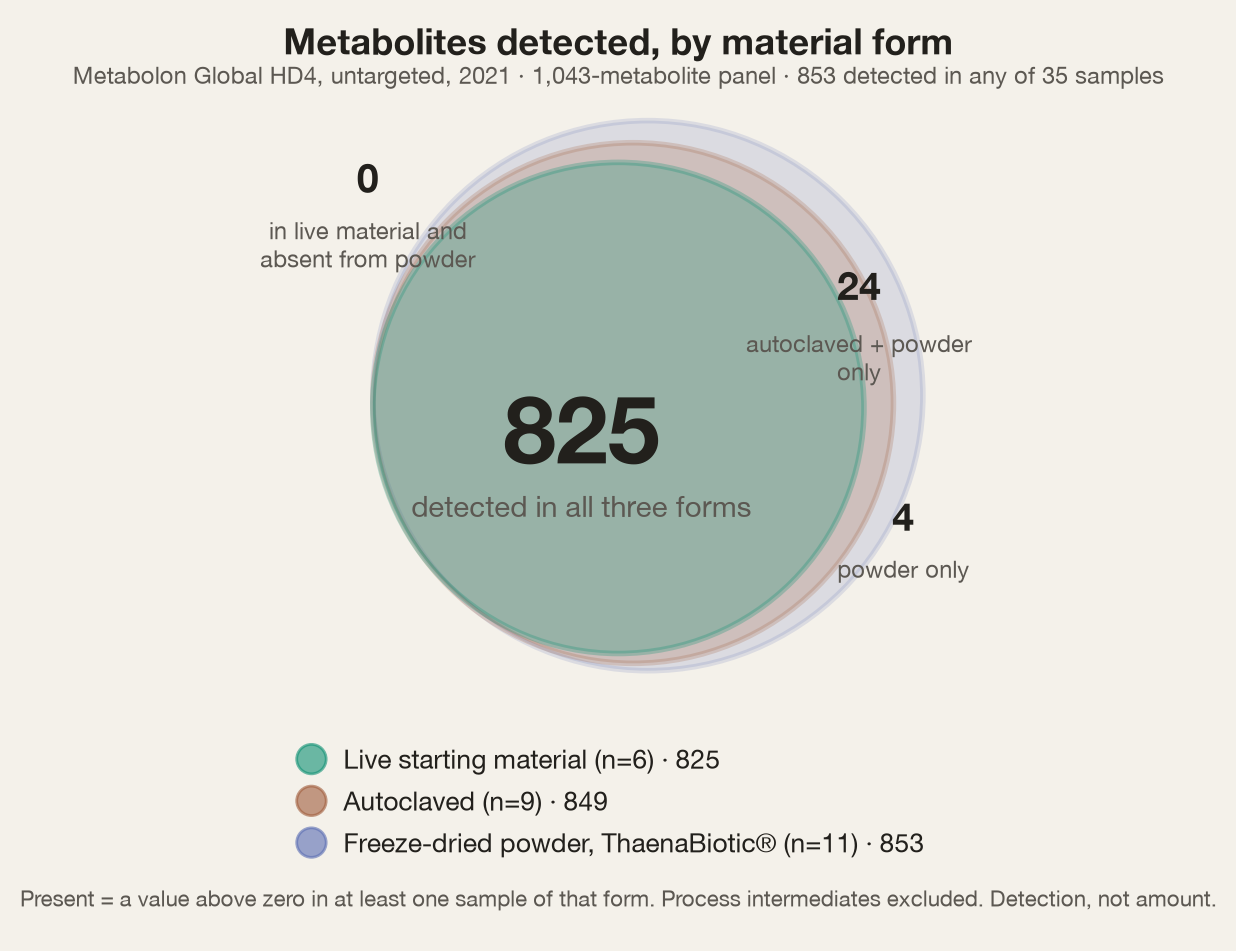
The live starting material (n=6), its autoclaved form (n=9), and the freeze-dried powder (n=11) were profiled side by side within a 35-sample untargeted run. Of a 1,043-metabolite panel, 853 were detected, and 825 were shared across all three forms. Using detection in every live sample as the starting criterion, we identified 617 biochemicals. Of these, 471 appeared in every finished-product sample, 146 appeared intermittently (in at least one but fewer than all product samples), and 0 were absent from all product samples. These counts describe detectable presence after processing. The platform measures relative peak area, so these findings do not establish how much of each biochemical processing retained.
A clean post-market safety record.
From 2023-11-01 through 2026-06-30 (32 months), passive post-market surveillance covered 16,900 distributed 30- and 90-count bottles of ThaenaBiotic®; 7-capsule sample units are excluded from the bottle denominator. The estimated-user denominator of 8,225 combines 3,072 direct-purchase customers with 5,153 provider patient-courses (463,770 provider capsules divided by 90 capsules per course). Zero serious adverse events were reported, and the per-user adverse-event reporting rate was under 2% against that denominator. Passive surveillance can miss events, its rates are not directly comparable to trial-reported rates, and whether sample-only recipients belong in the denominator remains unresolved.
What participants reported while taking ThaenaBiotic
- Published, peer-reviewed literatureThe studies above examine mechanisms and biological plausibility; they do not test ThaenaBiotic®.
- Thaena's own measurementsMetabolomics, contaminant testing, a sterility test on one lot of processed material, and passive post-market safety surveillance document different aspects of the product.
- Thaena's observational human dataParticipants recorded their experiences while taking it, in an uncontrolled study with no comparison group.
- The missing tierWe have not run a randomized controlled trial of ThaenaBiotic. That is our next study, and the observations below cannot establish cause.
About the study. CHLOE is Thaena's observational cohort: adults taking ThaenaBiotic® who consented to complete standardized symptom and quality-of-life questionnaires over time. It has no control group and no clinician assessment; participants scored their own symptoms. Because the analysis uses fully de-identified secondary data, it was classified as exempt from human-subjects oversight by the Institutional Review Board at the National University of Natural Medicine, per the study's principal investigator, Heather Zwickey, PhD, a co-author on the forthcoming paper.
At the September 8, 2026 data cut, CHLOE included paired first and last self-reported symptom scores from 77 participants with no prior product use; improvement counted any decrease in score. For bloating, 70.2% (40 of 57; 95% CI 57.3 to 80.5%) reported improvement at their last assessment, while 21% reported worsening; 57 of 77 had reported bloating at their first assessment. For abdominal pain, 70.0% (28 of 40; 95% CI 54.6 to 81.9%) reported improvement at their last assessment, while 20% reported worsening; 40 of 77 had reported pain at their first assessment. At their last assessment, 37.3% (22 of 59) reported no bloating and 45.0% (18 of 40) reported no abdominal pain. The bloating figures use different denominators because symptom absence comes from a yes/no item and improvement comes from a 0 to 100 severity score. High starting scores can drift down on their own (regression to the mean); we checked whether participants who started without the symptom drifted upward and found they did not, and that check cannot rule it out.
We are preparing a paper for publication that will set out the study's methods, participants' reports and limitations.
Full References
The complete peer-reviewed backbone behind the Science Hub. The studies above are drawn from this list.
Microbiome & host biology
- →Human Microbiome Project Consortium. Nature. 2012;486(7402):207–214.
- →Karu N, et al. Anal Chim Acta. 2018;1030:1–24. (Human Fecal Metabolome Database)
- →Rooks MG, Garrett WS. Nat Rev Immunol. 2016;16(6):341–352.
- →Cani PD, Knauf C. Mol Metab. 2016;5(9):743–752.
- →Mitra S, et al. J Adv Res. 2022;S2090-1232(22)00266-8. PMID 36496175. (brain modulation by the gut microbiota)
- →Belkaid Y, Harrison OJ. Immunity. 2017;46(4):562–576.
- →Hand TW, et al. Trends Endocrinol Metab. 2016;27(12):831–843.
- →Weiss GA, Hennet T. Cell Mol Life Sci. 2017;74(16):2959–2977.
What we've lost
- →Sonnenburg ED, et al. Nature. 2016. PMID 26762459.
- →Schnorr SL, et al. Nat Commun. 2014;5:3654. PMID 24736369. (Hadza)
- →Clemente JC, et al. Sci Adv. 2015;1(3):e1500183. PMID 26229982. (Yanomami)
- →Smits SA, et al. Science. 2017. PMID 28839072. (Hadza seasonal cycling)
- →Duvallet C, Gibbons SM, Gurry T, Irizarry RA, Alm EJ. Nat Commun. 2017;8(1):1784. PMID 29209090.
- →Wastyk HC, et al. Cell. 2021;184(16):4137–4153.e14.
- →Jernberg C, et al. ISME J. 2007;1(1):56–66. (antibiotic depletion, up to 2 years)
- →Palleja A, et al. Nat Microbiol. 2018;3(11):1255–1265. (antibiotic depletion, ~6 months)
FMT efficacy & delivery
- →van Nood E, et al. N Engl J Med. 2013;368(5):407–415. PMID 23323867.
- →Juul FE, et al. N Engl J Med. 2018;378(26):2535–2536.
- →Kelly CR, et al. Ann Intern Med. 2016;165(9):609–616.
- →Cammarota G, et al. Aliment Pharmacol Ther. 2015;41(9):835–843.
- →Kao D, et al. JAMA. 2017;318(20):1985–1993.
- →Staley C, et al. Am J Gastroenterol. 2017;112(6):940–947.
- →Moayyedi P, et al. Gastroenterology. 2015;149(1):102–109.e6. PMID 25857665.
- →Vrieze A, et al. Gastroenterology. 2012;143(4):913–916.e7. PMID 22728514.
- →Yu EW, et al. PLoS Med. 2020;17(3).
- →Kang DW, et al. Microbiome. 2017;5(1):10. PMID 28122648.
- →Kang DW, et al. Sci Rep. 2019;9(1):5821. PMID 30967657. (ASD 2-year follow-up)
- →Xue LJ, et al. Medicine (Baltimore). 2020;99(35):e22035. (Parkinson’s)
- →Bajaj JS, et al. Hepatology. 2017;66(6):1727–1738. PMID 28586116. (hepatic encephalopathy: clinical result)
- →Bajaj JS, et al. JCI Insight. 2019;4(24):133410. (mechanistic follow-up)
- →Baruch EN, et al. Science. 2021;371(6529):602–609. PMID 33303685.
- →Davar D, et al. Science. 2021;371(6529):595–602. PMID 33542131.
Mechanism of FMT beyond live bacteria / broad therapeutic potential
- →Antushevich H. Clin Chim Acta. 2020;503:90–98.
- →Wortelboer K, et al. EBioMedicine. 2019;44:716–729.
- →Wilson BC, et al. Front Cell Infect Microbiol. 2019;9:2. (super-donor)
- →Smillie CS, et al. Cell Host Microbe. 2018;23(2):229–240.e5.
- →Nusbaum DJ, et al. FEMS Microbiol Ecol. 2018;94(9).
- →Martinez-Gili L, et al. Gut Microbes. 2020;12(1):1810531. (metabolite contribution)
- →Chen D, et al. Int J Cancer. 2019;145(8):2021–2031.
Bile acids & SCFAs in C. diff resolution
- →Sorg JA, Sonenshein AL. J Bacteriol. 2009;191(3):1115–1117.
- →Thanissery R, et al. Anaerobe. 2017;45:86–100.
- →McDonald JAK, et al. Gastroenterology. 2018;155(5):1495–1507.e15. (valerate)
- →Allegretti JR, et al. Aliment Pharmacol Ther. 2016;43(11):1142–1153.
- →Brown JRM, et al. BMC Gastroenterol. 2018;18.
- →Weingarden AR, et al. Am J Physiol Gastrointest Liver Physiol. 2014;306(4):G310–319.
- →Seekatz AM, et al. Anaerobe. 2018;53:64–73.
Dead still works: postbiotic evidence
- →Ott SJ, et al. Gastroenterology. 2017;152(4):799–811.e7.
- →Depommier C, et al. Nat Med. 2019;25(7):1096–1103. PMID 31263284.
- →Plovier H, et al. Nat Med. 2017;23:107–113.
- →Piqué N, et al. Int J Mol Sci. 2019;20(10):E2534.
- →Gao X, et al. PeerJ. 2019;7:e7117.
- →Wei CL, et al. Brain Res. 2019;1711:202–213.
- →Malagón-Rojas JN, et al. Nutrients. 2020;12(2):E389.
- →Thakur BK, et al. Int Immunopharmacol. 2016;36:39–50.
- →Sang LX, et al. Int J Clin Exp Med. 2015;8(11):20072–20078.
- →Karimi Ardestani S, Tafvizi F, Tajabadi Ebrahimi M. Hum Exp Toxicol. 2019;38(9):1069–1081. PMID 31117840. (heat-killed probiotic bacteria, HT-29 colon adenocarcinoma cells, in vitro)
- →Chung IC, et al. Nutrients. 2019;11(3):516. PMID 30823406. (heat-killed probiotic, NLRP3 inflammasome, colitis-associated colorectal cancer in mice)
T-regulatory cells / immune modulation
- →Smith PM, et al. Science. 2013;341(6145):569–573.
- →Arpaia N, et al. Nature. 2013;504(7480):451–455.
- →Campbell C, et al. Nature. 2020;581(7809):475–479.
- →Song X, et al. Nature. 2020;577(7790):410–415.
SCFA mechanisms
- →Chang PV, et al. Proc Natl Acad Sci. 2014;111(6):2247–2252.
- →Wong JMW, et al. J Clin Gastroenterol. 2006;40(3):235–243.
- →den Besten G, et al. Am J Physiol Gastrointest Liver Physiol. 2013;305(12):G900–910.
- →Bergman EN. Physiol Rev. 1990;70(2):567–590.
- →Cummings JH, et al. Gut. 1987;28(10):1221–1227.
Tryptophan / indole metabolites
- →Ye L, et al. Cell Host Microbe. 2021;29(2):179–196.e9.
- →Bansal T, et al. Proc Natl Acad Sci USA. 2010;107(1):228–233.
- →Rothhammer V, Quintana FJ. Nat Rev Immunol. 2019;19(3):184–197. (AhR)
- →Alexeev EE, et al. Am J Pathol. 2018;188(5):1183–1194. (IL-10R)
Bile-acid signaling drugs
- →Neuschwander-Tetri BA, et al. Lancet. 2015. (obeticholic acid / FXR, NASH)
- →Hofmann AF. 1989. (oral bile-acid therapy)
Neural (gut–brain)
- →Kaelberer MM, et al. Science. 2018;361(6408):eaat5236. PMID 30237325.
- →Yano JM, et al. Cell. 2015;161(2):264–276. PMID 25860609.
- →Tolhurst G, et al. Diabetes. 2012;61(2):364–371. PMID 22190648.
Sterilization standards
- →World Health Organization. WHO Infection Control Guidelines for TSEs. 2000.
- →Rutala WA, Weber DJ (HICPAC). CDC Guideline for Disinfection and Sterilization in Healthcare Facilities, 2008; update May 2019.
Freeze-drying / stability
- →Ueyama J, et al. Anal Biochem. 2020;589:113508.
- →Hsu YL, et al. J Proteome Res. 2019;18(5):1948–1957.
- →PubChem CID 311: citric acid (excipient reference).
Internal data
- →Thaena, Inc. Untargeted metabolomics, Metabolon Global HD4. 2021. 35-sample run; 1,043-metabolite panel, 853 detected. 825 shared across the three finished forms (live n=6, autoclaved n=9, freeze-dried n=11).
- →Thaena, Inc. Post-market surveillance summary. Data cut 2026-06-30, window 2023-11-01 to 2026-06-30. 8,225 estimated users, 16,900 distributed 30- and 90-count bottles, per-user adverse-event rate under 2%, 0 serious.
- →Thaena, Inc. ThaenaBiotic vs NIST RM 8048 (Servetas SL et al., NIST SP 260-252, 2026, doi:10.6028/NIST.SP.260-252). Computed 2026-09-06 on InChIKey skeletons across four platforms: 209 of 461 NIST-named compounds present, 79 of 95 NMR polar-core compounds, 0 of 36 pharmaceutical or industrial compounds.
Seen enough? The rest is up to you.
These statements have not been evaluated by the Food and Drug Administration. This product is not intended to diagnose, treat, cure, or prevent any disease. ThaenaBiotic® is a dietary supplement. The research summarized on these pages describes the science behind our approach; it does not describe what ThaenaBiotic does for any person or condition.