
Chapter Four
The Solution
We can't grow back the bugs we've lost. But we can restore the signals they would have made.
Part One
Tools in the toolbox
Restoring a depleted ecosystem isn't one intervention. Several tools work together, and you already know most of them.
Good, when the ecosystem can still use it. But you can't always eat your way back: in low-diversity guts more fiber didn't lower inflammation (Wastyk 2021), and when the Sonnenburg lab restored fiber after four low-fiber generations, the lost diversity never returned. Fiber feeds a working gut; it can't rebuild a depleted one.
In the same study, healthy adults eating a diet rich in fermented foods developed more diverse gut microbiomes. Their inflammatory markers also declined over the course of the study (Wastyk 2021).
With caveats. Off-the-shelf multi-strain probiotics taken after antibiotics can delay native recovery (Suez 2018, Cell). A place in the toolbox, but more isn't always better.
Prebiotics are materials that certain microbes in the body selectively use, with a documented health benefit. Synbiotics combine live microbes with materials those microbes selectively use, with a benefit from the combination. Postbiotics are preparations of inanimate microbes, their components, or both, with a documented health benefit. [→ ISAPP definitions: Gibson 2017, Swanson 2020, Salminen 2021]
ThaenaBiotic® is a stool-derived postbiotic: a preparation of inanimate microbes and their components from a screened donor's healthy, diverse gut community. We start with that whole community's output instead of growing a single strain in a tank. Processing turns it into a shelf-stable capsule that delivers 10,000+ molecular signals.
"ThaenaBiotic is one tool in your toolbox. Not the only one, but a good one."Andrea McBeth, ND
The first four are familiar: you can find them in any grocery store or supplement aisle, and each has a real place. ThaenaBiotic is the newcomer, and it works on a different principle. Instead of feeding your gut or adding more live bacteria, it delivers the finished signals a healthy, diverse microbiome already makes. That's the part worth explaining.
Gut health advice assumes unlimited time, money and energy. A menu for people trying to get through the week.
Part Two
It's the molecules, not the microbes
The idea this chapter turns on: the gut's real currency isn't the bacteria. It's what they make. A thriving microbiome is a busy chemistry set: more than a thousand distinct metabolites, from short-chain fatty acids to bile acids to signaling compounds, that your gut and the rest of your body are built to read [→ Zierer 2018]. A depleted gut isn't just missing bugs. It has gone quiet. It has stopped making the signals.
Fecal transplant is a medical procedure that transfers a healthy donor's whole stool community into a patient's gut. Clinical studies show it can resolve recurrent or refractory C. difficile infection [→ Quraishi 2017]. FDA-approved fecal microbiota products are limited to preventing recurrence in adults after antibiotic treatment; conventional fecal transplant remains investigational. That brings us back to the chemistry: we need to understand what the living bacteria contribute, what the molecules they carry contribute, and what signals they make after transfer.
A review of the 2026 literature on why the field is moving from counting microbes to measuring what they make. It is a reading of published research, not a ThaenaBiotic study, and ThaenaBiotic has not been studied for SIBO.
Which raises a strange, useful question: if the molecules are the point, do you even need the living bacteria to deliver them? The research keeps landing on the same answer. You don't.
Fecal transplant is used for recurrent C. difficile under FDA oversight, and it has been studied at research stage across a range of other conditions. Those are studies of a clinical procedure, not of ThaenaBiotic. What matters here is narrower and more useful: they are the reason anyone looked at what is doing the work.
Part Three
Why a healthy, diverse donor
A transplant works by brute force. It transfers a large volume of a healthy donor's stool, often over several rounds, and effectively swaps your microbial population for theirs: new bugs, new chemistry, a whole new gut environment, all at once. It's powerful. It's also live, hard to source, and FDA-regulated, and it's too risky to hand people someone else's microbiome as a routine fix.
So the real question was whether the live bacteria were even the point. In 2017, a research team in Germany ran the experiment that pointed the way [→ Ott 2017].
- 1
They took stool from a healthy donor.
- 2
They filtered out every living bacterium.
- 3
They infused only the sterile, non-living filtrate, the metabolites, proteins, and signaling molecules left behind, into five patients with recurrent C. diff.
- →
All five resolved.
No live bacteria moved in, and all five improved. It's a small, uncontrolled series, and the authors are careful about what it shows: the active fraction could be metabolites, bacterial components, or the bacteriophages the filtrate still carried. But it points hard at one thing: the living bacteria may not be the part that matters.
And it isn't a one-off. Pasteurized, non-living Akkermansia muciniphila improved insulin sensitivity in a human trial, on some measures more than the live bacterium (Depommier 2019), and inanimate microbes and their components are now a formally defined category, with an international expert panel setting the definition and reviewing the evidence for health effects [→ Salminen 2021]. "Dead still works" isn't a fluke. [→ Evidence Library: why dead still works]
If the signals are the point, the next question is whose. Not all microbiomes are equal. Ours narrow over a lifetime: antibiotics, processed food, stress, less contact with soil and with each other. A narrowed ecosystem makes a narrower set of signals. It can't send messages it has lost the vocabulary for.
So we start with the opposite. ThaenaBiotic is built from donors with exceptionally healthy, richly diverse microbiomes, screened rigorously, chosen because their ecosystems still make the full spectrum of signals. It carries that spectrum to a gut that has gone quiet, a little at a time, capsule by capsule, rebuilding the chemical surroundings until the microbes you already have start behaving as if they're somewhere worth working.
Because every living microbe is removed in processing, there is nothing to colonize and nothing to take up residence. One tool in your toolbox. Not the only one, but a good one.
In early 2020, lockdown paused the clinical fecal-transplant work Thaena's founders were doing. The question that led to a sterilized postbiotic.
Part Four
Does the signal survive sterilization?
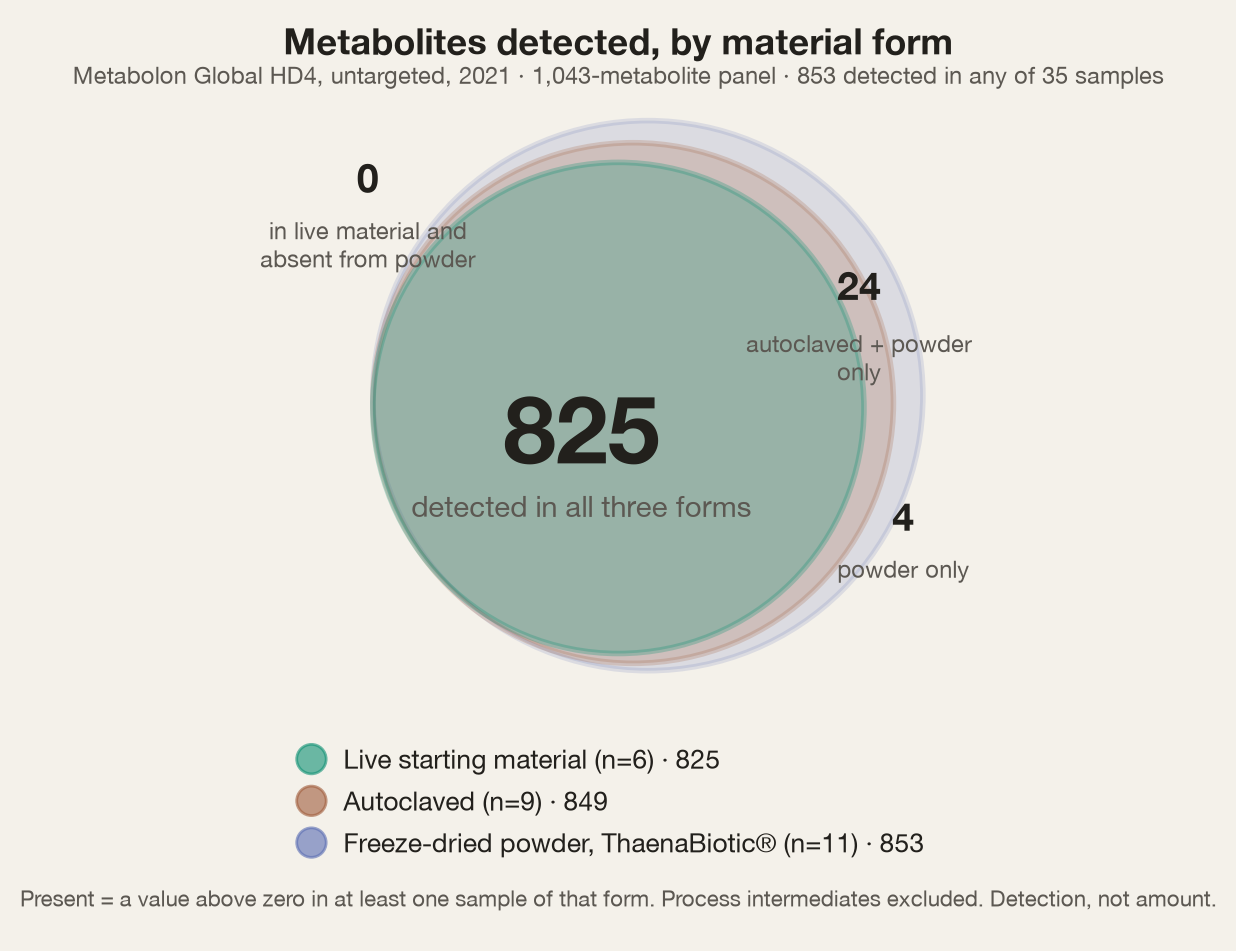
That points hard at the molecules. So the real test for ThaenaBiotic is whether the molecules survive what we do to the material. We measured: the live starting material, the same material after autoclaving, and the finished freeze-dried powder, side by side.
Untargeted metabolomics on the Metabolon Global HD4 platform, across 35 samples, covered a panel of 1,043 metabolites, of which 853 were detected. We detected every metabolite from the live material in at least some finished-product samples. Some appeared in every product sample; others appeared intermittently.
In plain terms: sterilizing and drying this material does not empty out its chemistry. The signaling repertoire of a healthy microbiome's output comes through the process. What we can say is which molecules are there, not how much of each; relative amounts do shift with sterilizing and drying.
"You can't synthesize healthy donor stool. You can't make synthetic blood, either. There's just too much complexity in it. So this material is the treasure. The question became: how do we sterilize it, and what's left when we do? As it turns out, almost everything that mattered."Andrea McBeth, ND | Founder, Thaena
Part Five
Longer vigor, not just more days
There's a trap in longevity research, and it was named in 2015 [→ Bansal 2015]. You can extend life and extend decline at the same time. When researchers at UMass tested four long-lived mutant worms, each using a well-studied longevity pathway, several lived considerably longer than normal. Every one of them spent a larger proportion of its life frail.
Gerontology has a name for the goal instead: compression of morbidity [→ Fries 1980]. Not more years. Fewer bad ones at the end.
We measured healthspan, not lifespan: in about 2,200 C. elegans worms on an automated imaging system, the day vigorous movement ended for 90% of each group. The goal was fewer frail days, what gerontology calls compression of morbidity. Each arm was compared with untreated worms only; this is not a head-to-head test of ThaenaBiotic against rapamycin or resveratrol. In 2022 we ran that study with InVivo Biosystems. Here is the share of each group still moving vigorously, day by day, and the day by which 90% of each group had made that transition.
Rapamycin and resveratrol are two of the most studied longevity compounds there are. In this study, ThaenaBiotic maintained vigorous movement later than any of the other treatments tested. Resveratrol showed no advantage at the point where 90% of animals had lost vigorous movement.
Now subtract. Lifespan minus the day vigor ended gives the frail window: how long each animal spent alive but declining. Untreated animals spent 7.1 days there, 29.2% of life. Rapamycin extended lifespan, more than anything else in the study, and stretched the frail window to 9.7 days, 33.3% of life. ThaenaBiotic was the only arm that moved it the other way: 6.1 days, 24.6%.
Lifespan was rapamycin's result. Healthspan was ours.
These are worms. The study has not been peer reviewed and has not been repeated by anyone else, and each treatment was compared to untreated animals, never head to head against the others. We keep coming back to it, and we would like someone independent to run it again.
The same question in people: thirty years of follow-up on a hundred thousand health professionals, and what separated the nine percent who reached seventy with mind, body and independence intact. Includes the gut-microbiome studies of frailty and extreme old age.
Part Six
And it's safe to take
A tool you can use also has to be safe to use. ThaenaBiotic is generally well-tolerated. When side effects happen, they're the ordinary ones you'd expect from almost any supplement: mild, gastrointestinal, and short-lived. And across more than 8,000 estimated users tracked after purchase through June 2026, we have recorded zero serious adverse events.
From November 2023 through June 2026, we collected reports through passive post-market surveillance: people telling us about their experience after using ThaenaBiotic®. Across 8,225 estimated users (direct customers plus estimated patient-courses through providers), we recorded zero serious adverse events, and fewer than 2% of users reported an adverse event of any kind.
Passive reporting can miss events, and this figure cannot be compared directly with clinical-trial rates, which use active follow-up.
Chapter V
So how do you actually make it?
Proving the science works is one thing. Turning rare donor material into something sterile, consistent, and safe, capsule after capsule, is a different problem. Two things have to be true every time: the source has to come from a healthy microbiome, and the process has to destroy every living thing in it without destroying the molecules that matter. The next page is how.
References
- 1van Nood E et al. N Engl J Med. 2013;368(5):407–415. PMID 23323867.
- 2Ott SJ et al. Gastroenterology. 2017;152(4):799–811. PMID 27866880.
- 3Wastyk HC et al. Cell. 2021. PMID 34256014.
- 4Sonnenburg ED et al. Nature. 2016. PMID 26762459.
- 5Suez J et al. Cell. 2018. PMID 30193113.
- 6Depommier C et al. Nat Med. 2019;25(7):1096–1103. PMID 31263284.
- 7Quraishi MN et al. Aliment Pharmacol Ther. 2017;46(5):479–493. PMID 28707337. (FMT for recurrent C. difficile, meta-analysis)
- 8Salminen S et al. Nat Rev Gastroenterol Hepatol. 2021;18(9):649–667. PMID 33948025. (ISAPP postbiotic definition)
- 9Zierer J et al. Nat Genet. 2018;50(6):790–795. PMID 29808030. (the fecal metabolome)
- 10Bansal A et al. Proc Natl Acad Sci U S A. 2015;112(3):E277–E286. PMID 25561524. (lifespan vs healthspan in C. elegans mutants)
- 11Fries JF. N Engl J Med. 1980;303(3):130–135. PMID 7383070. (compression of morbidity)
These statements have not been evaluated by the Food and Drug Administration. This product is not intended to diagnose, treat, cure, or prevent any disease. ThaenaBiotic® is a dietary supplement. The research summarized on these pages describes the science behind our approach; it does not describe what ThaenaBiotic does for any person or condition.